Top 10 Tips On Assessing The Ai And Machine Learning Models Of Ai Stock Predicting/Analyzing Trading Platforms
To guarantee accuracy, reliability, and practical insights, it’s essential to assess the AI and machine-learning (ML) models utilized by prediction and trading platforms. Models that are not properly designed or overhyped can result in financial losses and incorrect predictions. Here are the top 10 guidelines for evaluating the AI/ML models used by these platforms:
1. Learn about the goal and methodology of this model
Clarity of goal: Decide if this model is intended for trading in the short term or long-term investment, sentiment analysis, risk management, etc.
Algorithm transparency: Make sure that the platform provides information on the kinds of algorithms used (e.g., regression or decision trees, neural networks or reinforcement learning).
Customizability: Determine if the model can be tailored to your specific investment strategy or risk tolerance.
2. Evaluation of Model Performance Metrics
Accuracy: Make sure to check the model’s prediction accuracy and don’t solely rely on this measure, since it could be misleading when it comes to financial markets.
Recall and precision: Determine how well the model identifies real positives (e.g., correctly predicted price changes) and minimizes false positives.
Risk-adjusted returns: Find out whether the model’s predictions yield profitable trades after adjusting for risk (e.g. Sharpe ratio, Sortino coefficient).
3. Test the model using backtesting
Historical performance: Use previous data to test the model and assess what it would have done under past market conditions.
Testing outside of sample Conduct a test of the model using data that it was not trained on to prevent overfitting.
Analysis of scenarios: Check the model’s performance under different market conditions (e.g. bear markets, bull markets and high volatility).
4. Be sure to check for any overfitting
Overfitting Signs: Look out for models which perform exceptionally well when they are trained, but not so with data that is not trained.
Regularization: Determine if the platform uses regularization techniques like L1/L2 or dropouts to avoid excessive fitting.
Cross-validation: Ensure the platform uses cross-validation to assess the model’s generalizability.
5. Examine Feature Engineering
Find relevant features.
Selecting features: Ensure that the system selects features that are statistically significant and eliminate irrelevant or redundant data.
Dynamic features updates: Check whether the model adjusts with time to incorporate new features or to changing market conditions.
6. Evaluate Model Explainability
Interpretability: Ensure the model provides clear explanations for the model’s predictions (e.g. SHAP values, the importance of features).
Black-box models: Beware of platforms that use extremely complex models (e.g., deep neural networks) without explanation tools.
User-friendly insights : Find out if the platform offers actionable data in a format that traders can use and understand.
7. Examine the Model Adaptability
Market shifts: Find out whether the model can adapt to new market conditions, such as economic shifts and black swans.
Continuous learning: Verify that the platform updates the model by adding new data in order to improve the performance.
Feedback loops: Make sure your platform incorporates feedback from users or actual results to refine the model.
8. Be sure to look for Bias or Fairness.
Data biases: Ensure that the data for training are valid and free of biases.
Model bias – See whether your platform is actively monitoring the biases and reduces them in the model predictions.
Fairness – Make sure that the model you choose to use isn’t biased towards or against specific stocks or sectors.
9. Examine the Computational Effectiveness
Speed: Find out the speed of your model. to make predictions in real-time or with minimal delay, especially for high-frequency trading.
Scalability: Determine if a platform can handle several users and massive databases without affecting performance.
Resource usage: Check to make sure your model has been optimized to use efficient computing resources (e.g. GPU/TPU utilization).
Review Transparency & Accountability
Model documentation: Make sure that the platform offers comprehensive documentation on the model’s architecture, the training process as well as its drawbacks.
Third-party audits: Check whether the model was independently audited or validated by third-party auditors.
Error handling: Examine to see if the platform has mechanisms for detecting and correcting model mistakes.
Bonus Tips
User reviews Conduct research on users and study cases studies to evaluate the model’s performance in real life.
Trial period for free: Test the model’s accuracy and predictability by using a demo or a free trial.
Customer Support: Ensure that the platform has robust technical support or models-related assistance.
Follow these tips to assess AI and predictive models based on ML and ensure they are reliable and transparent, as well as compatible with trading goals. Read the recommended moved here on incite for website examples including ai stock trading app, ai stock, ai investment app, ai stock picker, best ai stock, ai stock trading, trading with ai, ai investment app, ai trading, best ai for trading and more.
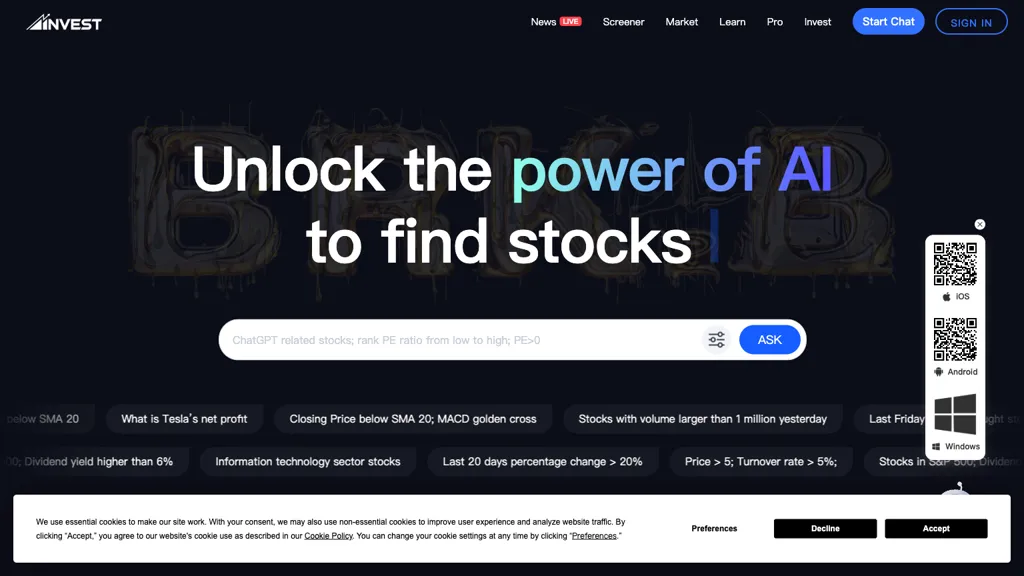
Top 10 Suggestions For Assessing The Ai Trading Platforms’ Educational Resources
It is essential for customers to evaluate the educational resources offered by AI-driven trading and stock prediction platforms to understand how to utilize the platform effectively, interpret results and make informed decisions. Here are 10 excellent strategies for evaluating these resources.
1. Comprehensive Tutorials & Guides
Tips: Check if the platform has tutorials that walk you through each step or user guides for advanced or beginners.
Why? Users are able to navigate the platform more easily with clear instructions.
2. Webinars & Video Demos
Look up webinars, video demonstrations, or live training sessions.
Why: Visual and interactive content can make complicated concepts more understandable.
3. Glossary of the terms
Tips. Check that your platform comes with a glossary that clarifies key AI- and financial terms.
This is to help users, especially those who are new, to understand the terms that are used on the platform.
4. Case Studies & Real-World Examples
TIP: Make sure there are case studies or examples of AI models being used in real world scenarios.
Why: Examples that demonstrate the functionality of the platform as well as its applications are offered to aid users in understanding it.
5. Interactive Learning Tools
Tip – Look for interactive features like quizzes and sandboxes.
Why Interactive Tools are beneficial: They let users test their skills, practice and improve without risking real money.
6. Content is regularly updated
Be aware of whether the educational materials are frequently updated to keep up with the latest trends in the market, as well as new features, or changes to the regulations.
Why: Outdated data can lead to misinterpretations or incorrect use of the platform.
7. Community Forums with Support
Search for forums that are active in communities or support groups that allow users to exchange ideas and share insights.
What’s the reason? Expert and peer guidance can help students learn and solve problems.
8. Programs that provide certification or accreditation
Find out if the school offers accredited or certified courses.
The reasons recognition of formal education can enhance credibility and encourage users to increase their education.
9. Accessibility and user-friendliness
Tips: Assess the accessibility and usability of educational resources (e.g., mobile friendly, downloadable pdfs).
Access to content is easy and lets users learn at the pace that is most suitable for them.
10. Feedback Mechanisms for Educational Content
Find out if students are able to provide feedback about educational resources.
The reason is that feedback from users can help increase the value and quality of the content.
Learn through a range formats
Make sure the platform has different learning formats that can be adapted to different types of learning (e.g. text, audio, video).
You can assess these factors to find out if the AI trading and stock prediction platform provides robust educational resources, which will allow you to maximize its capabilities and make educated trading choices. View the best ai copyright signals for site examples including ai stock predictions, trading ai tool, invest ai, free ai stock picker, best ai stocks to buy now, ai in stock market, best ai trading platform, chart analysis ai, best ai stocks, best stock prediction website and more.
